Accessing Muscle Memory

In June 2022, I tested for my 4th degree blackbelt in Taekwondo and I had practiced the hell out of my last 3 patterns.

I had practiced them all, of course, but those last 3, my newest ones, those needed extra work.

By the time my test came round, I was pretty confident in them. I had to take the last one a little slower than it would normally be done but I still knew it.

My brain knew it and my body knew it.

Then summer came and I was working on other things.

And in the fall, I started a new pattern and those 3 recent ones didn’t come up all that often.

Should I have been practicing them regularly anyway? Of course I should have.

Did I practice them regularly? Sadly, no.

I think it’s hard for anyone to keep practicing things they don’t use regularly but my ADHD brain throws up some extra challenges for me when it comes to that stuff.

I have trouble prioritizing on the best of days so on any given day, I‘m probably not going to be able to prioritize something that isn’t urgent.

And with my, let’s call it fluid, sense of time, it can feel like I *just* practiced something and, in reality, months have passed.

So, basically, while these patterns are technically there, in my brain and in my muscles, they weren’t easily accessible.

I could do them step-by-step along with the group but I no longer had a feel for them and I knew I had to prioritize practicing them or I might end up burying them too deep to retrieve.

So, in the past week, I have tried 3-4 times to go through those patterns. The first one was no problem. The second one was rusty but mostly doable – just a few sticky spots.

The third one though? My brain was refusing to let me have that one at all.

I could do the first few movements but that was it.

Then, on Thursday past, my back was being a jerk so I couldn’t participate in sparring class. Instead, I went to the back of the room and practiced my patterns.

I did the easy one, just to warm up.

Then I practiced the rusty one and as I did, I felt it become more and more familiar, like my muscles were saying ‘Oh, right! This one!’

And finally, I worked my way through the elusive third pattern.

Slowly, slowly, slowly, with some input from my friend and from my instructor, I eventually managed to remind my muscles that we know this pattern.

And, before I left class that night, it was back, it was accessible to me again, it was something I can more easily practice from now on.*

I just have to keep reminding my muscles that “We know this. We know this.”

*Again, I know everyone struggles to practice but my ADHD adds extra challenges in the task initiation area so there are *bonus* layers to my frustration with getting started with these things. And when I know practicing will be really slow and especially repetitive, my brain throws up an incredible level of resistance to the idea.

On laundry and executive function

The first item on my to do list this morning was to put my dobok (Taekwondo uniform) in the wash.

I meant to do it on Saturday but I was painting the living room that day so I put it off until Sunday. On Sunday, I was sick so I couldn’t go help with the TKD class anyway…you get the picture.

So, I had this reminder on my list today and after my tea, I was trying to talk myself into doing the laundry and get it out of the way.

Even though I know better, I was telling myself to ‘Just go do it! Just grab your dobok and put it in the washer.’

You may be reading that sentence and asking why I need to know better than to say that. If so, you probably don’t have ADHD – or at least yours is nothing like mine.

You see, for someone with executive function challenges, putting on a load of laundry isn’t just a one step thing. And it took me a long time to learn that ‘put on a load of laundry’ is shorthand for all of the steps involved.

A neurotypical person, or at least a neurotypical person who isn’t currently anxious or depressed, probably doesn’t realize how many steps there are in the process.

For me to put in a load of laundry, I have to walk myself through all of this:

  • Determining that laundry is, indeed, a priority right now
  • Reminding myself that, despite how it feels, laundry doesn’t actually take all day
  • Deciding to put aside all of the other things clamouring for my attention
  • Stopping the thing I am doing (even if it is just sitting at the table) and switching to the next task
  • Going upstairs
  • Choosing which clothes can go in the load with the needed item
  • Putting all the items in a basket
  • Bringing them down two flights of stairs while consciously ignoring all the visual clues of other things that need to be done
  • Possibly having to take clothes out of the dryer then put the clothes from the washer into the dryer and turn it on
  • Put current load into the washer and pay attention to all the settings that might need to change
  • Remember that the clothes are in the washer and need to go into the dryer (I usually set a timer to remind me)

That’s a lot of things when you put it out into a list, isn’t it?

For a neurotypical person, it’s usually compressed into ‘do laundry’ – a single task. But for someone who has trouble directing their attention, there are at least 11 decisions to make and 11 opportunities to get distracted.

Even the idea of walking through all of those steps and keeping my focus through all of those challenges feels tiring.

I do it, of course. I’m a grown up who knows she has ADHD and who has had to figure out ways to do the things that need doing.

But all of the irritation and frustration about it is still there, under the surface.

And there is always a chance that any one of those things could go sideways and get me off track.

So, that’s why telling myself to ‘Just do it! Just grab your dobok and put it in the washer!’ is something unhelpful for me to do.

Instead, I need to be kinder to myself, even in that small way.

Sometimes I need to itemize that list and check off each piece.

Sometimes, I set a timer and tell myself to jump up and get started when it goes off.

Sometimes, I need to reward myself for getting started, other times I reward myself for finishing.

Either way, I try to give myself what I need to get the job done.

After all, having a clean dobok is the goal and I can take any path that gets me there.

A Poem A Day In April

For the longest time I would respond to the question “What do you write?” with “Pretty much anything you’ll pay me to write…except poetry.”

It’s not that I don’t like poetry.

And it’s not that I can’t write poems.

It’s that I am not particularly drawn to write poems and I have never worked on my skills in that area.

I am much more comfortable in other forms or word work and I haven’t felt the need to dig into poetry.

And, of course, given how my brain works, I was forgetting that poets work in drafts the same as every other writer…the same as any other creative person.

Then, recently, I received Sage Cohen’s newsletter in which she mentioned her book Write a Poem a Day: 30 Prompts to Unleash Your Imagination and I was intrigued.

Could I write a poem every day for 30 days?

Well, if I didn’t worry about writing a *good* poem, I probably could.

And since lots of people write a poem a day in April (it’s poetry month!), it seemed like a good time to give it a whirl.

I didn’t officially join a challenge or anything, I just decided to putter along with it by myself.

And the first two days have been really interesting.

As I mentioned above, I had previously forgotten that poets wouldn’t just be able to create a perfect poem on the first try but I had come to realize that poets do drafts just like anyone else.

However, I hadn’t really thought about what that would mean from a ‘getting down to work’ standpoint.

I mean, when I need to write prose, I have long since abandoned the idea that I need to be inspired…

Wait, that’s not completely true.

My conscious mind has abandoned that idea but it still floats around my subconscious and keeps me from getting started sometimes. It’s only when I actually turn my conscious attention to a slow-starting project that I realize I have been waiting for inspiration.

In fact, ‘Are you waiting for inspiration?’ is the first thing on my list of check-in questions for when I am feeling stalled.

I am a professional writer. I know that inspiration often only kicks into gear once you are already writing.*

But, I guess, unconsciously, I saw poetry as something different, something a little more inspiration-fuelled.

However, on Saturday, April 1, when I read Sage Cohen’s prompt for day 1 and sat down with my notebook, I wasn’t inspired but I was determined.

So I did the same thing I do at the beginning of any writing project, I started putting words on paper,

And then I rearranged those words.

And then I added some more.

Took some away.

And then I had a poem.

Not a great but a decent one. Definitely one that I could shape into something better if I worked on it a bit more.

It was a really cool realization.

The process was the same. I could use the exact same skills and produce something entirely different.

Now, I’m not saying that two days of poems makes me a poet. And poetry commissions won’t be a thing.

But it has been amazing to realize that I can express ideas in poems by just sitting down and working at them.

I don’t need to know anything else.

I don’t need to build my skills first.

I can just keep moving words around until they end up in the right places.

And it’s fun.

*Yes, sometimes it shows up first and I am drawn to the page but mostly I decided to start writing and the act of getting started pulls inspiration to me.

A Pattern of Practice

I’m testing for my 4th degree black belt in two weeks and my brain is a jumble of theory, movements, pattern sequences, and exercises.

Luckily, it is finally starting to coalesce into something that feels doable, something I am building on because it has been several months of inching forward and my brain is not a fan of increments.

In fact, my brain would prefer it if I could spend a whole day learning everything and keep it permanently in my head.

If only that would work, one day of overload but then I’d know everything.

A GIF of a skull with flashing images where the brain should be.?
A GIF of a skull with flashing images where the brain should be.

May 1: Low Key

I want a lot out of this month but I am trying to teach myself to add things slowly instead of trying to do everything all at once.

After all, I know that successful changes, new practices, come from starting small and building up.

BUT

I also know that jumping right into a bunch of new practices all at once feels good. I feel engaged and energetic and accomplished…until I run out of steam.

And despite the fact that I run out of steam EVERY SINGLE TIME, my brain still wants to chase that excited feeling of doing ALL OF THE THINGS.

Without the benefits of medication and experience, I would be planning to do more art, more writing, more exercise, more Taekwon-do, more house organizing, more everything all at once, starting right now, maybe half an hour of each, on top of what I already do each day.

It would be fun today but by the end of the week, I would be out of steam.

So, instead, I am layering all of those things into my life during May.

I will ‘touch’ each habit each day but only really focus on one at a time.

Let’s see how it goes.

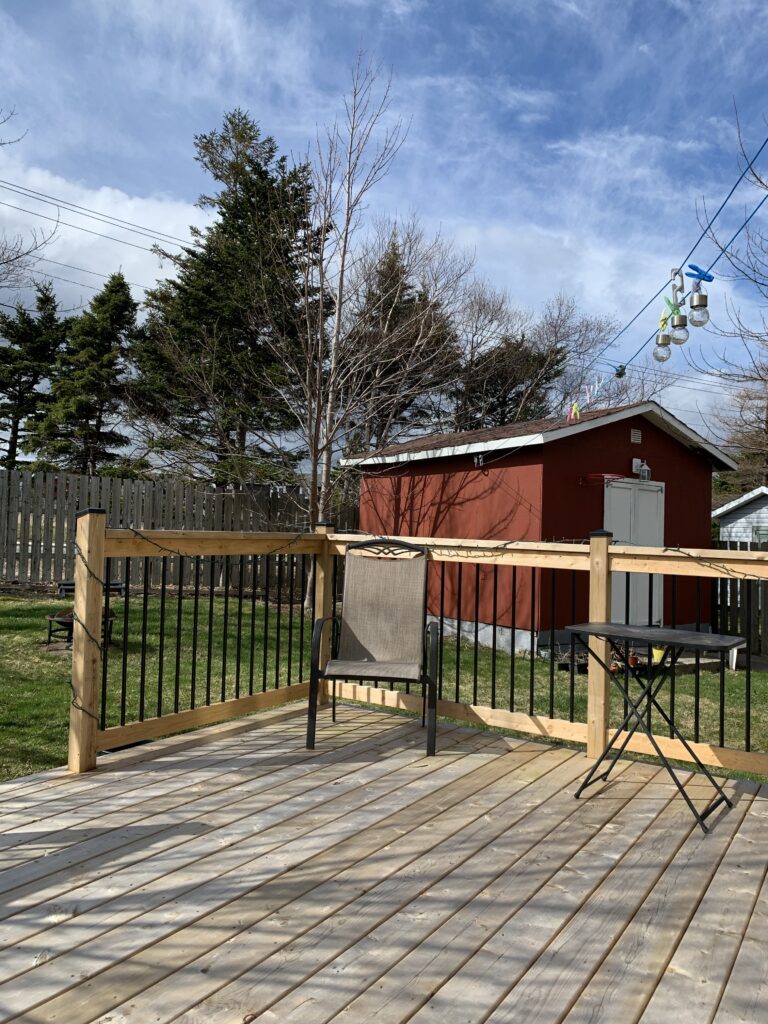
?a view of a backyard patio with bare trees in the background
My patio and trees are on the same plan that I am – the basics in place but we’ll add new things a little at a time and let them grow. Image description: The view from one corner of my patio. A lawn chair is directly across from me and beyond that there are trees that don’t have any leaves on them next to my red shed.